• SLIDER-1-TITLE-HERE

    Replace these every slider sentences with your featured post descriptions.Go to Blogger edit html and find these sentences.Now replace these with your own descriptions.This theme is Bloggerized by Lasantha - Premiumbloggertemplates.com [...]

  • SLIDER-2-TITLE-HERE

    Replace these every slider sentences with your featured post descriptions.Go to Blogger edit html and find these sentences.Now replace these with your own descriptions.This theme is Bloggerized by Lasantha - Premiumbloggertemplates.com [...]

  • SLIDER-3-TITLE-HERE

    Replace these every slider sentences with your featured post descriptions.Go to Blogger edit html and find these sentences.Now replace these with your own descriptions.This theme is Bloggerized by Lasantha - Premiumbloggertemplates.com [...]

  • SLIDER-4-TITLE-HERE

    Replace these every slider sentences with your featured post descriptions.Go to Blogger edit html and find these sentences.Now replace these with your own descriptions.This theme is Bloggerized by Lasantha - Premiumbloggertemplates.com [...]

Showing posts with label Movies. Show all posts

Heat Wave!

Posted by febry on 6:32 PM

When it's pushing 100 in Minneapolis, and the dewpoint is near 80, what says it better?


Peter Falk, R.I.P.

Posted by febry on 5:45 PM

One more thing. There was always just one more thing with Peter Falk.

Twice he was nominated for Academy Awards for Supporting Actor (Murder, Inc. and Pocketful of Miracles). He could have continued as a supporting actor, he could have made a career of playing the heavy. He was nominated for two Emmys for guest-starring roles in early 60s television, wining one. He could have been a terrific television character actor. His first television series, a lawyer drama called The Trials of O'Brien, was cancelled after one season. He could have hopped from one series to another, ala McLean Stevenson and Robert Urich.

All of these things could have happened, but there was always one more thing.

There was Columbo. This will be his crowing achievement, one of the greatest television characters of all time, with plots that were worthy of his talent, and guest stars who were bigger than the featured stars of most series. The story is that Bing Crosby turned down the chance to play Columbo because it would interfere with his golf game. Bing Crosby would not have done justice to the role, not in the same way that Peter Falk did. It was so successful that, after the original series ended, he came back a few years later and launched another version, and it was a hit, too.


This would have been enough for some actors, but there was always one more thing. He didn't stop making movies. He made The In-Laws with Alan Arkin, and everyone who's seen it seems to have a favorite scene.


Now, a lot of TV stars are able to make a good movie or two - ask Helen Hunt. But there was one more thing.

He had a charming appearance in a very strange movie, Wim Wenders' wonderful Wings of Desire, playing himself as an angel  Yup. But it worked.


He played the grandpa in The Princess Bride. A lot of memorable scenes in that movie. Falk was content to stay in the background. But would there have been a story without him?


As I say, there always seemed to be one more thing with Peter Falk. Just when it would have been easy to remember him as he was, to look back in appreciation at what he had done, he came up with something new. And so, when it came out a year or so ago that he had Alzheimer's, it was a bitter pill: not just because of the personal tragedy, but because this time there wouldn't be one more thing, he wouldn't come back to add another memorable moment to his terrific career.

And so when Peter Falk died last week, it was the end. But, of course, it was also the beginning. Because when you look back at what Peter Falk did, the guest apperances and the movies and Columbo and the rest, you realize that as long as that work exists, as long as you can bring it up on your TV or DVD or laptop, there will always be, after all, one more thing.  

Don't leave it to "The Beaver"

Posted by febry on 7:49 AM

First things first: Mel Gibson delivers a brilliant performance in The Beaver, Jodie Foster's movie about a man's breakup and redemption. It may well have been his best performance since Gallipoli, and were it not for his current state of disgrace, there would surely be an Oscar nomination in his future. Perhaps even that won't be enough to keep him from a nomination, since there are few things Hollywood likes more than a good comeback story; but I still think it's a longshot. Nonetheless, his portrait of a tortured man hanging on to sanity, filled with loathing for others and himself, had to have given us an insight into the man that one seldom gets from an actor. He wasn't playing a role so much as he was using his own experience to interpret the role. If his own life is anything like this (and I think it is), I have the greatest compassion for him.

There was also a lot to like from the script, which led us down one road, toward the seemingly inevitable feel-good conclusion, and then took us in a completely different direction. Hitchcock, who was a master at mixing light humor with dark terror, often showed us that the most effective horror comes from the inoccuous - and what could be more inoccuous than a motley beaver hand-puppet?

Indeed, as The Beaver opens, we are presented with the portrait of a man - Walter Black - on the verge of self-destruction. He is deeply depressed (although, unless I missed it, we are never told exactly if there was a single episode that tipped him over the edge, only that depression appears to run in the family), unable to find help from any form of treatment (amusingly shown in a montage with voiceover), and his wife (Jodie Foster) has packed up their two kids and left him. Alone and drunk, on the verge of suicide, he discovers the puppet - who, the next thing he knows, has taken over his therapy. And wouldn't you know, the Beaver seems to be the only one who can actually penetrate the fog and reach Black where it counts. (One might wonder if the fact that Gibson voices the Beaver with no attempt at ventriloquism is meant to suggest that the answers have been inside him all the time, blocked by a lack of self-confidence, but the script misses the opportunity to go there. Not the only opportunity it misses.)

So far, so good. Black returns to his family a new man, charming younger son Henry (Riley Thomas Stewart) and giving his wife a cautious optimism. Only older son Porter (Anton Yelchin) remains antagonistic - but Porter has his own problems,* and it's clear that he's already well along on the same road to mental illness that his father and grandfather have already trod. Perhaps we're supposed to feel some sympathy for Porter, but I didn't - I kept thinking someone should have sat down with him a long time ago and laid down the line.

*Starting perhaps with his name? A wimpy name like Porter is perhaps the strongest evidence of how disengaged Walter must have been in this marriage.

And here we start to get into the greatest problem with The Beaver: Jodie Foster herself. Foster has shown some skill in past as a director, and her two Academy Awards are testimony to her talent, but in this role she's completely out of her element. Foster's Meredith is far too much a co-dependent, unable to reach either her husband or her two children, who desperately need parenting and aren't getting it. Foster's great strength as an actress is just that: her strength. And a weak character like this is not for her, not at all. It would not be hard to understand how Walter could come to feel that only the Beaver cares for him; I could not imagine that Meredith ever could have given Walter what he needed. Foster can, and should, play a stronger character - but more about this shortly.

I don't generally like to give away the ending of a movie, but in this case I feel I have to in order to prove my point. [PLOT SPOILERS AHEAD] Near the end, we find out that the Beaver has taken over Walter, convincing him that only he has Walter's best interests at heart, that his family has betrayed him, that everyone else has betrayed him, that he must listen only to the Beaver. (A point of view for which I had some sympathy, by the way.) We now see that Walter, in addition to being depressed, might also be schitzophrenic.* He no longer has control over the Beaver, who now controls him.

*A bit which Anthony Hopkins, Foster's Silence of the Lambs mate, did much better in a much better movie, Magic.

When Walter, sensing this, tries to call Meredith on the phone, the Beaver forces him to hang up, and proceeds to beat Walter up (in a scene that's much more horrifying and less silly than it sounds). Now, we're presented the opportunity for Foster to shine, perhaps directly confronting the Beaver (something she has been loathe to do, always talking to Walter instead), willing to do anything to save the man she loves, even if it puts her own life in danger. 

But no. The plot drums up the lame excuse that Meredith has to stay with an ill younger son, and sends the older son to check on his father. To his horror, Porter discovers that Walter, realizing that he must escape the Beaver in order to survive, has cut his own arm off to rid himself of the puppet.

This was the point at which the film finally lost me. And this is the reason why The Beaver ultimately fails.

In her best roles, I've always thought Jodie Foster had something of Barbara Stanwyck in her. Stanwyck was a tough broad (and I say that with admiration), who didn't take anything from anyone. As the heavy, she could put the fear of God into you; as the heroine, you knew she'd fight to the death for what was right I(and thank your lucky stars that she was on your side). Now, imagine Stanwyck in this role, going to Walter and confronting the Beaver, treating it as if it were alive (as, in a way, it is), screaming "Give me back my husband, damn you!" She wouldn't have been afraid to fight the Beaver, and Walter too, if that were needed. And my money would have been on her. It would have been a ferocious, terrifying scene. And it would have guaranteed Stanwyck an Oscar nomination.

Foster, I think, could have pulled this scene off. Maybe this sudden toughness would have seemed too much out of character. Perhaps, given Gibson's personal history of confrontational relationships, there was some discomfort about the possibility of a physical confrontation between Foster and the puppet, which surely would have meant Foster vs. Gibson. Maybe she and the writer thought such a confrontation smacked too much of a stereotypical thrillier, ala Fatal Attraction. On the other hand, maybe they should have tried doing a drama cum thriller, rather than a comedy-drama.

Alas, we're only allowed to review the movie at hand, not the movie as it might (should?) have been. And that's why The Beaver winds up a failure: a noble one, perhaps, an ambitious one, full of promise (I haven't even mentioned the excellent performance of Jennifer Lawrence as Porter's girlfriend, who shines in a somewhat tortured subplot). But a failure nonetheless. It's best not even to discuss the film's end, which is either a too-pat happily-ever-after finish, or a hopefull, this-is-the-ending-that-might-be that was executed with too much subtlety.

In the last analysis, Jodie Foster the director was let down by Kyle Killen, the writer, and - perhaps more importantly - by Jodie Foster, the actress. For when Mel Gibson, whose strength has always been in action movies, shines as the most sensitive actor in your drama, you know you're in trouble. 

There Be Dragons

Posted by febry on 8:20 PM

A film ostensibly about the early life up until his 30s of St. Josemaria Escriva, the founder of Opus Dei, who was canonized in 2002 by Blessed John Paul II. There are only tangential references in the film to the lay apostolate founded by the saint in 1928, designed for Catholics to learn to sanctify themselves through their secular work. And not much about St. Josemaria’s early life and education. Today, Opus Dei has 90,000 members around the world with 2,000 priests, most of them deemed to be quite well educated and very influential in the Catholic Church.

The film tells the complex story of the Spanish Civil War (1936-39) when hundreds of thousands of people in Spain were killed in a fraternal war between the conservative Nationalists backed by fascist Italy and Nazi Germany and the socialist and communist Republicans, backed by the Soviet Union (and lots of intellectuals and kindred souls from the U.S. and other European countries, motivated by the ravages of the Great Depression and the ensuing enthusiasm for revolution). During that war, when thousands of priests, nuns and other religious were singled out and killed, St. Josemaria’s role seemed to be somewhat fictionalized to help tell the complex story. But it’s an interesting story if you’re a history geek like me.

It’s a hard story to tell, but I thought that the Director, Roland Joffé, well know for his films, “The Mission” and “The Killing Fields”, did a great job on this complex film featuring love, faith, jealousy, revenge, civil war, family relationships, reconciliation and death. The cinematography and especially the combat scenes I thought were particularly good.

I’ve never known much about the Spanish Civil War, the practice event for World War II. The Germans tested their flying and bombing skills there to great effect. Picasso’s “Guernica” painting is world famous for depicting an early aerial bombing raid of an undefended city. The Russians tried to do that but at the same time, Stalin was purging most of the General Staff of the Soviet armed forces on manufactured grounds of treason. So it didn’t do them much good. Thus, the Spanish nationalists, under General Francisco Franco, ultimately defeated the Republicans supported by Stalin.

When I enlisted in the U.S. Army in 1964, one of the last things I had to do before I took an oath of loyalty to the United States and its Army, was to sign a disclosure sheet stating that I was not then nor ever had been a member of a list of a 100 or so organizations that I had never heard of. Anxious to avoid the draft and combat duty, I diligently plodded my way through the list, pondering each name and checking “no” and then moving on to the next. About halfway through the list, the officer in charge just said to us all, “You haven’t been in those groups, just check ‘no’ and give me the sheets!”. The only two names that I do recall from the list were, the “Abraham Lincoln Brigade”, later that I found out was the most significant American unit in the Spanish Civil War, and the “Chopin Cultural Society.” I never did find out what that was all about. But they both dated to the time of the Spanish Civil War. I passed, and did my four years.

Go see it. It’s good! The film probably won’t be around for long. I attended the 4:45 showing this afternoon and as I left, the cleanup crew seemed to be larger than the number of us who paid to see it. (I missed out on the free tickets that were floating around).

History stutters, destiny triumphs

Posted by febry on 4:49 PM

To what shall I compare thee, The King’s Speech? Art thou a moving testimonial to the resilience of the human will, a gripping historical narrative, a story of a wife’s devotion to her husband – or a highbrow version of a movie genre best known as the Disease of the Week?

There’s probably been enough discussion on the web regarding the historical inaccuracies of The King’s Speech – everything from the timeline of events to the nature of the relationship within the royal family to the true story of Churchill’s involvement in the abdication crisis. We needn’t review them here; links exist if you want to peruse them (Here, here and here for starters).

No, the point of this is not that the movie wasn’t 100% gospel, although there’s a lot to be said for historical accuracy, and much to be inferred from movies that play fast and loose with it. The point is that all lying, or fudging of the truth, is an attempt at manipulation. Storytelling itself, even when the story is completely and absolutely true, is manipulation as well, in that the purpose of the storyteller is to elicit a certain response from the audience. The reason we don’t think about this more often is that the best storytelling is done subtly, with a sure and confident hand, and if the story moves at a rapid enough pace we don’t even realize we’ve been had until much later, if ever. The best storytellers can have you eating out of their hand when you didn’t know you were even hungry.

What this leads to is a moment in Westminster Abbey during the preparations for the king’s coronation when the thought occurred to me: I am being manipulated. And as soon as I realized that, the enjoyment of the movie vanished. It was a moment that was telegraphed, for anyone to see if they had been looking for it. It was the precise point in time when the king confronts the doctor with the revelation that he has found out the truth, that the doctor is not and never was a doctor, and that his entire reputation has been built on a series of falsehoods and fabrications. It is The Crisis Moment, the pivotal moment when a conflict is introduced that threatens to tear apart the fabric of what up to that point had promised to be a Feel-Good Story. It’s the football star who’s ruled ineligible on the eve of the Big Game, the woman who walks out on her boyfriend just before the wedding due to a tragic misunderstanding – most movies have one, and usually one look at your watch will reassure you that everything will be cleared up in the end, because it’s not time for the movie to be over yet.

So this was The Crisis Moment of The King’s Speech, and it even had a Bad Guy to make the Crisis more appealing – the Vicar, who clearly resented the doctor’s involvement in the whole process, primarily because the Vicar hadn’t been responsible for introducing him to the king. We know that the Vicar will eventually lose this battle, for after all the moment of the King’s Speech hasn’t come yet and the doctor still has plenty of work to do. Sure enough, the doctor is able to explain himself, the king succeeds with his small speaking role in the ceremony, and we can get on to the major work of the movie – preparing for the King’s Speech.

As for the Speech itself – well, vis the title, this is what the whole movie works up to. George was, in a sense, born for this cinematic moment. Will he pull it off? Is the Pope Catholic? You might have figured the filmmakers weren’t about to make a movie about a king who absolutely blew it on a live microphone in a moment of grave crisis for his people. But one of the challenges to portraying historical events in a movie (or book, for that matter) is the eternal question of how to keep the suspense alive. One of the great compliments anyone can give such a story is the comment Judie had following the movie Apollo 13, when she said “I knew how it was going to end, and I still found myself wondering if they were going to make it.” Now that’s suspense – and I didn’t get that from The King’s Speech. Not for one minute.

Having passed through The Crisis Moment, we now arrive at the Climax – the speech itself – and this director isn’t about to let you forget it. As the king steps to the microphone, the fortunes of the entire Empire riding on his tied tongue, the second movement of Beethoven’s Seventh Symphony starts up. Let me say here that my admiration for this piece of music is second to no one’s. If you only heard one of Beethoven’s compositions in your life, this is the one that would convince you he was a genius. It is atmospheric beyond imagination, running the gamut between sorrow and triumph. But its use as backdrop to the speech was beyond manipulation. It was as if the director didn’t trust the actual words of George’s speechwriter, which were stirring enough, to make the point. But then, in an era where we even have background music in public restrooms, I suppose a speech without a soundtrack is unimaginable. Sure enough, the king pulls it off (and, it must be said, the actor does a remarkable job of mimicking the real-life speech), and as sure as if Clark Kent just stepped out of a phonebooth, he leaves the broadcasting booth transformed: a new, and changed, man.

I don’t want to make it sound as if there was nothing good about this movie – the look of it was fantastic. The historical detail (other than in the script) was impressive, especially the reproduction of old Wembley Stadium at the movie’s outset. Geoffrey Rush was, as usual, solid; for my money it should have been him, and not Colin Firth, in the Best Actor category. Helena Bonham Carter, as Queen Elizabeth (aka the Queen Mum to you and me) was passable (if mannered; she never let you forget for a moment that she was acting), with just enough of a hint of the shrew about her to suggest that she was a woman most men would not have wanted for a mother-in-law. Maybe it was something about the eyes. On the other hand, if that was not the effect she was trying for, then the performance was no credit to her.

Firth won an Oscar for Best Actor, but then so have Richard Dreyfuss and Roberto Benigni, so that’s no point in his favor. I was underwhelmed by this performance – with the exception of an early scene with daughters Elizabeth and Margaret, his George struck me as a cold, and not particularly likeable, fish, part snob and part dolt. One of the key essentials to Crisis Moment movies is that you have a rooting interest in the hero, and I just couldn’t do that with Firth. The only reason I wanted him to get over the stutter is because of Rush – otherwise, I couldn’t give a damn. If he hadn’t been part of the royal family, I’m sure he would have fit right in alongside Bertie Wooster at the Drones Club. The rest of the royal family, particularly George and Edward, were unlikeable, as the filmmakers intended them to be. Whether or not they were portrayed accurately is a matter of taste, I suppose. And this whole review has, in one way or another, reflected back on the director, which means we’ve said enough about him.

All in all, The King’s Speech was, for me, a movie that left a sour taste in the mouth, a movie that diminishes in statue the farther one gets from it, although apparently this opinion puts me in a very small minority. Oh well. It’s a movie that won awards and sold tickets, and since that’s what it was bred for, you’d have to consider it a success by any measure, regardless of what you might think of it.

Finally, I have to admit, and I take no pride in it, that while I consider myself a fairly learned individual, I had no idea George had made such an important speech to the British people. Like many of you, I suspect, the only wartime speeches with which I was familiar were the ones that came from Churchill. And since I was able to find recordings of the speech on YouTube, recordings that were posted long before this movie came out, I’m forced to concede that this was indeed an important speech. I also can’t really say that I was aware of George’s stutter, although upon further reflection I do recall my mother (who was decidedly not an Anglophile) once remarking that she’d always thought George was a little bit, shall we say, slow in the thinker, and I suppose his speech impediment caused a lot of people to think that way.*

*See I, Claudius, who was, of course, played by Derek Jacobi – who also played the Vicar in this movie.

So, to the extent that this movie introduced me to a piece of history that I wasn’t familiar with, I suppose it did some good. At least it encouraged me to read more about it, where I was able to find out what the true story really was.

But I left the theater feeling as if I’d been played, and I don’t like to feel that way.


*****


The opening minutes of Winston Churchill: Walking With Destiny present, in some remarkable color footage of Churchill’s funeral, the image of a woman weeping as the funeral cortege passes by. Even though Churchill was 90 and had been in poor health for some time, his death, as narrator Ben Kingsley comments, still came as a shock to a people that revered Churchill as a link to Britain’s Finest Hour. And I wondered, as I saw the woman gently wiping away her tears, and later watched the scenes of teeming crowds pass by Churchill’s bier, whether or not there had been the same honest emotion at the time of George’s death. Admiration, yes. An affection for the monarchy, certainly. But grief? Not having been there, I can’t say for sure.

But I can say that I came away from this documentary with even more respect for Churchill than I’d had previously, which was already considerable. While George found himself forced into a role that he didn’t want (and did it well; the decision of George and Elizabeth to remain in London rather than flee to Canada for their own protection provided immense moral encouragement to the people), Churchill was forced into a role that he himself wound up creating – a kind of latter-day Lord Protector of the Realm. The movie focuses on the years 1940-41, beginning after a brief prologue with Churchill’s ascent to Prime Minister, and concluding with his Christmastime trip to the United States following the bombing of Pearl Harbor. For most of that time Britain was forced to stand alone against what appeared to be an unstoppable Nazi powerhouse, and Churchill had been one of the first to sense the threat Hitler posed, going back as when he was merely Chancellor in the Hindenberg administration. With the fall of France, it was left to Churchill to cajole and convince America of the need to enter the war on the side of the Allies.

There’s something stirring about watching Churchill defiantly challenging the Germans, while encouraging the British people to rediscover the strong stuff of which they were made. Since we’re bound to do it, we’re also forced to contrast the stammering George with the smooth Churchill, especially in the later’s speech to a joint session of Congress in which he remarks, to a roar of laughter and cheers, that had his father been American and his mother British instead of the other way around, he might have come to speak before Congress more honestly. (President Churchill, anyone?)

Naturally, any documentary about Churchill is going to have Churchill as the focal point. As such, we get less about FDR’s initiative in convincing the American public, as well as Congress, to take sides in the war. As well, while the king isn’t ignored, it’s apparent the filmmakers consider Churchill the true hero of the war, particularly in an instance when Churchill and George, while dining together, are interrupted by a German air raid. George was content to head to the safety of the shelter, but Churchill insisted on going to the roof to watch the action first hand. (No record as to whether or not George joined him.) And since the movie was produced by the Wiesenthal Foundation, there are several examples given of Churchill’s fairness to Jews and defense of the right to a Jewish homeland, which might have otherwise seemed out of the narrative stream.* And the soundtrack, which is filled with lovely and stirring music, nonetheless suffers from the occasional bombastic orchestral arrangement that seems just a little wrong for the moment.

* Particularly in pointing out Churchill’s concern that the Atlantic Treaty, which encouraged self-determination in government, could result in Arabs blocking the creation of a Jewish state following the war. While this was undoubtedly one of Churchill’s concerns, I think it likely that he was more concerned about the effects the Treaty would have on Britain’s colonial holdings, especially India.

These minor quibbles aside (and even the word quibble might be strong), this movie, in a little under two hours, reminds us all of the power of heroic virtue, and the influence that can have not only on individuals, but on an entire nation. And while there are different paths to, and different kinds of, heroism, there will always be a need for heroes, and it’s good to have that demonstrated from time to time.

Walking With Destiny is an antidote, a cleansing of the pallet from the bad taste left by The King’s Speech – one which I, at least, needed.

Oceans apart

Posted by febry on 5:51 AM

When you're in the midst of a torrential downpour, as we are in Minneapolis today, your thoughts naturally turn to water: namely, the oceans of water now floating across our parking lot. And with this not-so-subtle segue, we take a look at this piece by Mark Steyn comparing the old and new(er) versions of the classic caper flic Oceans 11 (and 12 and 13). Put simply, it's like comparing Frank Sinatra and George Clooney. 'Nuff said? Take a gander, and try not to drown in the differences.  

Retro TV Friday

Posted by febry on 7:54 PM

John Barry, who for my money was the greatest film composer ever, died last week. I meant to write something about it at the time, but I didn't get the time. And I don't have as much time now as I'd like to have to talk about just how great a composer he was. He didn't write movie music; he wrote music that was used in movies.

But here's a clip of a TV theme that Barry wrote - to the swinging 70s show The Persuaders!, starring Tony Curtis and Roger Moore.A British import, shown on ABC (ala The Avengers), it didn't fare as well, but it's still good fun.


As for some of John Barry's other work - well, I'd wager you might recognize one or two of these.

Who's that guy?

Posted by febry on 3:25 PM

Guest Post by Cathy of Alex

A few days ago one of the most unique of British actors passed away: Pete Postlethwaite, died at the age of 64. Who? You ask.

Be honest. Would you have recognized the name without the photo (at right)? Oh, THAT guy. And, still, some of you may not recognize him or know his name. It helps to be a fan of British TV or arty, smaller budget films or TV series of the last 20 years.

I first noticed him as the nemesis of Richard Sharpe, Obadiah Hakeswill, in the first Sharpe’s miniseries in the early 90s. Unless you are a fan of local public television in the Twin Cities you may not have ever seen the series which is a crying shame in my humble opinion. Postlethwaite is a study in evil. He’s very Shakespearean in his manners; twitching and clever.

He’s an odd looking man. Very angular and raw. Not quite handsome, not quite ugly, but decidedly noticable. He’s what is usually called “a character actor” which is a term I usually equate with “scene stealer” Put him a scene and the lead actor better be on their game or the entire episode or film will be stolen.

Speaking of Shakespeare, maybe you remember Postlethwaite as the Priest in Baz Luhrmann’s Romeo + Juliet ? Most of us remember Leo, the beach, the fish tank and a lot of buffed young men with guns from that film. But, Postlethwaite was there and, unsurprising, able to make an odd role over in his own image.

Or, maybe you remember him in the second Jurassic Park film?

More than likely you remember him from The Usual Suspects -probably his biggest stateside role.

Besides his role in Sharpe I see him, forever, as the seemingly out of touch conductor of a brass band in a dying mining town in Brassed Off His surprising and impassioned speech at the end could only have been pulled off by Postlethwaite as during the rest of the film he seems completely out of touch with any reality other than music, yet, surprisingly he was paying attention and was well aware the whole time. Suddenly, we realize that music was an escape for him as much as it was for the miners in the band.

If you saw Inception recall that Postlethwaite spent his role on his back in a hospital bed and is shown in only two brief scenes with scarcely any dialogue. A lesser actor would have faded into the sheets-not Postlethwaite.

This post is a shout out to, not only Postlethwaite, but all the actors who give us enjoyment but whose names are not always, or ever, above the marquee. Consider the following names: J.T. Walsh, Terry O’Quinn (who prior to his breakout in “Lost” was largely unknown), Jessica Walter, Lance LeGault, Lance Henriksen, Ben Johnson, Slim Pickens, Judith Chapman,Christine Belford, Jeff Mackay, Strother Martin, Denholm Elliot. Some of these actors have passed away, and some continue to find work, but no matter they will continue to entertain via Hulu, DVD, Netflix, TCM, AMC or daily reruns on cable or satellite TV.

Bud Greenspan, R.I.P.

Posted by febry on 4:11 PM

To cut to the chase: Bud Greenspan was the best film documentarian there was.  Period.  Better than the Burns brothers, Ken and Ric, who did so much to popularize the long form documentary.  Better than the father-and-son team of Ed and Steve Sabol, whose NFL Films played a major role in forming the modern conception of the National Football League.  Better than David L. Wolper, who made the television documentary so accessible in the 60s and 70s.  Better than Errol Morris, whose Thin Blue Line transcended the genre to be seen as a mainstream movie.  Better even than Michael Moore.

Perhaps the only documentarian in the same league with Greenspan was Leni Riefenstahl, and it's ironic that both of them came to their greatest fame through the Olympics, for it was Greenspan's epic 1976 television series The Olympiad that first brought him widespread fame.  There was just something about the Greenspan style; his companion and business partner, Nancy Beffa, described it well:

Bud was a storyteller first and foremost. He never lost his sense of wonder and he never wavered in the stories he wanted to tell, nor how he told them.  No schmalzy music, no fog machines, none of that. He wanted to show why athletes endured what they did and how they accomplished what so few people ever do.
And that's exactly it.  No mawkishness, no tinkling piano music - things that have undone many a fine documentary.  David Perry's sparse, precise, emotionless narration was the perfect compliment to Greenspan's stories.  With all due respect to voiceover giants such as John Facenda*, Perry (who, incidentally, was Greenspan's brother) never distracted from the importance of the words he spoke.  Ken Burns may have perfected the art of celebrity narrators speaking in the voices of his subjects, but Perry's anonymous omnipresence underscored, rather than overlayed, the powerful images on screen.

*Also known as The Voice of God.

Another thing about Greenspan's technique:: sound effects.  Many of them were dubbed in, of course (doubtful that there were sound movies of the 1904 Olympics), but the very artificality of them only heightened the drama.  The lonely sounds - a shoe digging into the gravel of the track, the heavy breathing of the long-distance runner, the echoless shot of the starter's pistol, the silence broken by the roar of the crowd - isolated Greenspan's film images in a way that made them stand out even more than as if they had been shot in 3-D.  For that single moment sports was not of this world, not of the mundane, but existed in a vacuum where the only things that mattered were the athlete and the finish line.  Much, one might imagine, as the athletes themselves might have experienced it.

If you listened to Greenspan's prose being spoken, or caught a glimpse of him on television, you might have thought him a serious, perhaps even humorless man.  Not so.  In his frequent appearances with Johnny Carson (Greenspan wearing his trademark turtleneck, glasses perched on top of his bald head*), he often brought along very funny sports blooper reels, on which he commented with a dry sense of humor.

*True story.  I saw Greenspan on Tonight once, his glasses in their customary place, and Carson cracked everyone up with a comment about how Greenspan must have been looking out of the top of his head, or something like that.  It was much funnier when Johnny said it, and would have been funnier now if I could remember it exactly.  But the memory of it is still funny to me.

He and his late wife Cappy were true partners until her death in 1982 (he named the production company after her, Cappy Productions).  He once said of her that "Everything I wrote, I used her as my model. I talked about courage and spirit and endurance and talent, and for all my scripts I used Cappy as an example. I told her that once. She said, 'Aw, go on.' I said, 'Listening to Beethoven and thinking about you is very inspiring.' "

The Olympics weren't Greenspan's only gig on the sporting scene.  For several years in the early 80s, back before the Heisman Trophy went all Hollywood (or all ESPN, at any rate), Greenspan produced the syndicated Heisman broadcast, with its centerpiece being three or four ten-minute vinettes on past Heisman winners.  Done with all the Greenspan trademarks, including Perry's narration, those profiles brought to life the dramatic stories of Ernie Davis, Johnny Rodgers, Nile Kinnick, John Huarte, and other winners - some household names, others mere footnotes in the fog of sports history.  In Greenspan's hands, they became titans: not overhyped superheroes, but quiet men pursuring a dream.  Unlike the show today, it was - dignified.

And that's a good word to use to describe Bud Greenspan's work.  He didn't romanticize sports, didn't gloss over its faults or pretend everything was a fairytale.  He returned to Berlin with Jesse Owens, told the story of Larry Doby (the first black American League player), covered the horror of the Munich Olympics.  He won seven Emmys, a Peabody, Lifetime Achievement awards from the Directors Guild and the Emmys, and was inducted into a bunch of halls of fame.  Not bad for a lifetime, but if you ask me, the real award was the work that Bud Greenspan did, and the true winners were those of us who had the chance to view them.

Bud Greenspan died on Christmas Day of Parkinson's, at the age of 84.  Through it all, he gave you the whole picture, straight up, no chaser.  And nobody did it better.  

The mockingbird that don't sing

Posted by febry on 6:38 AM

I must admit that I've never been a fan of Harper Lee's To Kill a Mockingbird - not in high school, when I had to read its earnest social message, and not the movie version, featuring Gregory Peck's wooden performace. (And how that perforance won an Oscar, up against Albert Finney's in Tom Jones, I'll never know.) Gratifyingly, it turns out I'm not the only one.

Cultural outrage

Posted by febry on 4:35 AM

The Hensons Doing Raunchy Television? The Henson family (whose well-known Muppet characters are now in control by another company) has developed a new puppet-based programme, Late Night Liars, on Sony's GSN that is extremely raunchy and designed for the late-night time slots in the Eastern time zone. Is this a Henson programme or is this just another cable-specific, pile on the rauncy type?

Shut The Television Mid-Sequence? Speaking of Sony, Glee ends Series Two (officially the first season, but because of its split-season format, it is Series Two because both halves are separate series because of the long break, as many UK television shows refer to them) with the awful glee club that does not know what are legitimate songs for school choirs to sing. The song list I have received (some friends watch this show faithfully -- I had no time because of dance classes during the first part of Series Two and now this summer choral project has me tied in knots to not watch it) has me wanting to eat dinner with my dance partner, and then the lights turned off. (See "Made in America" for the reason.)

Those Who Forget History . . . In the movie To Wong Foo, Thanks For Everything, Julie Newmar, a World Golf Hall of Fame member was prodded by a transvestite's character using his name for the character that led to litigation. If a certain Asian character on Glee becomes raunchy or unfaithful in certain ways, we may seen an International Tennis Hall of Fame member who is a current member of the Champions Series Tennis tour (older than 30, national Copa Davis team member, or finalist at a major) with a similar name go into the law books and request a cease and desist.

Here We Go Again. The United Nations Convention on the Rights of the Child, signed in 1995 by Madeline Albright, has lurked 15 years in the United States Senate. The outrageous treaty, not ratified yet, has been used by the Supreme Court in their moving of the nation's legislative capital to Bruxelles. With nearly a three-fifths supermajority, liberals believe the time is now to pass laws to wipe parents off the map and replace them with government.

The Ultimate Perversion. Homosexual activists received a major boost when President Obama revived the Clinton-era policy of declaring June homosexual month, celebrating Stonewall and the Constitutional Right to Sodomy. These activists are absurd, and their behaviour is even worse. In doing an investigation, I talked to a photographer who does her works at art museums and based on what she told me, I learned how perverted they were that art designed for women has been purchased by these sexual deviants.

Conquering With a Mosque. The Al Aqsa Mosque was built on the ruins of the Temple Mount. Mosques were built on Constantinople replacing cathedrals to show the victory of Islam. Now plans are to build a mosque near Ground Zero which shows the victory of Al Qaeda in destroying the central point of business in New York. Victory over infidels mean a mosque in that area.

D-Day. In Long Pond, Pennsylvania, D-Day was celebrated with the victory of the Axis Powers (Japan) over the Allied Powers (United States).

Opinion Digest

Posted by febry on 6:46 AM

The news you need to read...

Mark Steyn: Memorial Day reflections on "The Battle Hymn of the Republic.

James Allen: Hamilton wins wild GP of Turkey; Red Bull self-destructs before our very eyes.

Charles Krauthammer: There's more than enough blame to go around in the Gulf oil disaster - and you might be surprised by some of them.

Thomas Sowell: Don't let scapegoating distract us from real problems.

Dennis Hopper, R.I.P.  The two things I remember most about Dennis Hopper are that he was a vocal supporter of Ronald Reagan, and that he couldn't believe he'd gotten an Oscar nomination for Hoosiers rather than Blue Velvet:   "Hoosiers?  I got it for Hoosiers?"  Oh yeah, he also made some movie called Easy Rider.  There's a temptation to think that perhaps that's more than Dennis Hopper himself remembers about his life (it's sure more than he remembers about his turn in Apocalypse Now), but his life truly was quite a time.  Joe Neumeier offers some thoughts on Hopper's legacy

Foul Play: Late-70s flashback

Posted by febry on 4:59 AM

Written by Cathy of Alex

I was browsing the “On Demand” offerings a while back and turned my attention to the “Free Movies” category. Occasionally, I can find an interesting freebie to select.

Foul Play from 1978 was one of the free offerings. I’ve not seen Foul Play for what must be, at least, 10 years.

I was 10 when Foul Play came out. My parents wouldn’t let me see it. I can’t remember if it was an R. In any event, my parents monitored by theater going pretty closely. The first time I saw it was on an evening movie offering, probably something like “CBS Night at the Movies” a year after it was theatrically released. I watched it with my friend Ann in her cool basement and we sat on her water bed. A typically cool, finished, 70s basement. Stereo, basement rotary phone (green), paneled walls, “Toy in the Attic”.

I seem to remember the movie did well at the box office.

It involves Goldie Hawn’s librarian character, unwittingly (you didn’t think she was playing a rocket scientist did you?), stumbling onto a plot to assasinate the Pope (a fictitious Pope Pius XIII) by a “Tax the Churches League”. There’s an albino, a dwarf, Gilbert & Sullivan, “Stayin’ Alive” and two songs, (yes two songs!) by Barry Manilow (who was hot then like Lionel Ritchie was in the 80s and T.I. today!)

It was interesting to view it again. I thought it was hilarious that the intro to the film “On Demand” was the TCM Movie Classics bit with Ben Mankiewicz. Alec Baldwin must have been out of the country or busy doing the “Marriage Ref”. Seriously, Foul Play is worthy of a TCM opening bit? It’s a classic? It’s even THAT good? No.

It’s a classic in the sense that it’s a cultural artifact. It’s SO 70s. I amused myself with the dialogue, the singles bar, the music (Barry Manilow-you know how down I am with The Nose! Would “Weekend In New England have been a better musical choice?), the reel-to-reel players, the wicker, the ferns, the alka-seltzer commercial plays on a TV in one scene (Plop, plop, fizz, fizz), the John Denver look alike, the big floral couch fabric with matching curtains, the plaid sport coats, the wide lapels, pantie lines, zebra striped sheets, cross hatch head boards, chest hair, and Dudley Moore still can’t get laid.

There’s also the bizarro alternate reality of how a drop dead BLONDE babe like Goldie Hawn is supposed to be believable as a dowdy librarian who can’t find a date in San Francisco(shockingly there appear to be no gay men in San Francisco-another bizarro tidbit). She drives up the coast in a VW convertible with the top UP (probably supposed to be a reference to her seeming uptightness-yet she never wears a bra in the entire movie). Oh, did I mention Chevy Chase (for the love of humanity) is supposed to be sexy cop? (except he looks like a complete doofus with a pseudo comb-over. I thought he was hotter in the National Lampoon films). Also, Hawn lives in an apartment that NO public librarian I’ve ever known could afford. Chase is supposed to be an “on the outs with the sarge cop who lives on a houseboat”, surely “Miami Vice” stole their ideas from Foul Play! Chase’s houseboat bachelor pad, crushingly, lacks a beanbag cushion or an egg chair. Seriously, I’m crushed when I don’t see either of those in a 70s film. I was waiting for Chase to pull out a shag rake and invite Hawn to help him comb his rug! ROFL! See, I should write B movie dialogue!!!.

Foul Play is supposed to be a Hitchcockian homage of some kind. I’ve seen the movie several times and I never picked up on the Hitchcock references. It could be because I was young when I first saw the film or it could be that the Hitchcock references are so subtle. Ok, they are really bad and so obvious that it’s almost groan inducing. Friends, when you are going to do The Master of Suspense you better load for bear not bunnies.

The movie is actually really bad. It’s not even funny overall. However, there are a couple unwitting howlers. “I never knew there was such diversity!”: Hawn about Moore’s blow-up doll collection. The midget Bible salesman was told by Hawn’s PASTOR to go see her? Huh? Never saw that comin’. Hawn’s ultra feminist friend who thinks every man is a rapist in disguise (also very 70s) wears a neon colored, sateen, leotard top to the police station (Remembering that fashion trend I just about died laughing)

Astonishingly, this a film about SAN FRANCISCO in the 70s and no one smokes a joint!! Now, how believeable is that? I definitely think it probably helps to be stoned to view this film. Smoke a big bowl, order some pizza and eat a whole bag of Doritos…ok, where was I? Oh, yes. There is a scene where Chase’s character invites Hawn to smoke a joint with him and she says “No, I don’t do that anymore” Not exactly “Just say no” but we have to know that at some point in her life she was wild and crazy, right?

The Pope in this film is either a dithering idiot or a really kind and gentle man. Like the 70’s he is who he is-no judgement on it! Something for everyone in this film. This/that. It’s by no means an anti-Catholic film. It’s not a pro-Catholic film either. See, like the 70s, it makes no stand. Like the entire decade: not militant like the 60s, not small government, right-wing reassertion like the 80s. It’s just there. In the moment-like this movie.

It is interesting to compare the career of Goldie Hawn with that of her daughter Kate Hudson. Will their early films be their best roles? They both specialize in light, romantic, adventure fare. Neither of them met a foundation undergarment they could stand to wear. Neither of them smoke in their films, curious as Hawn is still a heavy smoker and Hudson smokes as well. Hawn gets caught on camera looking longingly at a pack of Marlboros. I think Hawn has had the same hair style for her whole life.

See Foul Play as a cultural artifact of the late-70s make a party of out it! A drinking game might be fun too! Every time “Ready to Take a Chance Again” comes on either sung or on the soundtrack as an orchestral number take a drink. You’ll be bombed within an hour.

John Forsythe, R.I.P.

Posted by febry on 1:39 PM

John Forsythe had a pretty good career. He was on three hit television series, which is three more than most of us and at least two more than many of today’s so-called stars. He was once referred to as “the epitome of the suave leading man." He was constantly surrounded on screen by beautiful women. I think we can agree that the man was pretty successful.

There was also an ease with which he handled many of these roles, particularly when he wasn’t the dominant character on the screen. Take the disembodied voice in Charlie’s Angels, for example, or the proto-anti-hero in Dynasty, the corrupt judge in And Justice For All, or the man trying so hard to hide the dead body in The Trouble With Harry.

My point is, you don’t remember the voice of Charles Townsend nearly as much as you do his angels bouncing (literally) across your screen.* You don’t remember Blake Carrington nearly as much as you do his his scheming, over-the-top, bitchy ex-wife Alexis (Joan Collins).** He was frequently upstaged by the painfully young Shirley MacLaine in The Trouble With Harry, and if Al Pacino had chewed up any more scenery than he did, they’d have had to have his stomach pumped. Yet I’d be willing to suggest that without John Forsythe, none of them would have held together as well. Even when he wasn’t center stage, it was impossible to miss him

* When I wrote this line originally, I typed “angles” instead of “angels”. Freudian slip, obviously.

** Who had some pretty good angles herself.


John Forsythe first hit the television jackpot with his 50s series Bachelor Father, where he played Bentley Gregg, a wealthy playboy (how could you not be with a name like that?) who abruptly finds himself father to his suddenly orphaned niece.* Bachelor Father was a hit for five seasons, and he followed it with a couple of seasons of To Rome With Love in the late 60s and early 70s, along with appearances on other shows and specials, not to mention Topaz, In Cold Blood, and other big screen movies.

* It was a rerun of Bachelor Father which the NBC affiliate in New York preempted with the first bulletin of JFK’s assassination. Just thought you’d like to know.

His unlikely return to stardom came courtesy of the 80s soap Dynasty, where he managed to avoid not only Collins’ claws but Linda Evans’ shoulder pads and still emerge with his dignity intact. It was the role of a lifetime for him, and he made the most of it. He was, in his 60s, a sex symbol all over again.*

* He was not the first choice to for the lead in Dynasty, incidentally. It was George Peppard, who turned it down (he claimed) or had a run-in with the show’s writers (they claimed) and wound up instead on The A Team. People laughed at Peppard and his bad fortune. For awhile. When The A Team became a hit, they stopped laughing.

Nevertheless, I’d like to think that people remember John Forsythe for more than just Dynasty, or Charlie’s Angels. I myself think of Bentley Gregg, who came along a decade before Brian Keith’s turn on Family Affair, or the world-weary writer Al Manheim in What Makes Sammy Run?, or the major determined to find A Bell for Adono on the Hallmark Hall of Fame. There were those, and many more roles, from a career that spanned seven decades in movies and television.

John Forsythe died on April 1, at the age of 92. As I said, not a bad career at all.

It's Lincoln's Birthday - Honest, Abe

Posted by febry on 1:10 PM

Whether we celebrate it or not, February 12 is in fact Abraham Lincoln's birthday, and although Abe's undergone something of a cultural renaissance in the last few years (Team of Rivals, etc.), we still let this day go by too easily.

'Twas not always the case. Here's a clip from John Ford's 1939 movie Young Mr. Lincoln, featuring young Henry Fonda in the title role.

The Academy Awards, R.I.P.

Posted by febry on 6:53 AM

With the announcement of the Academy Awards nominees this morning (who knew?), particularly in the newly-expanded (ten, up from five) list of Best Picture nominees, one thing is now apparent: The Academy Award is no longer an award; it’s a certificate of appreciation; and the show itself is no longer about competition, but recognition. It’s a pity that David Letterman doesn’t host this show anymore, because the Best Picture race is now little more than one of his Top Ten lists.*

*Yes, I know that back in the early days of the Oscars the Best Picture list was larger – as many as twelve movies some years. Of course, that was also in the days when you had movies such as Gone With the Wind, Mr. Smith Goes to Washington, The Wizard of Oz, and Stagecoach getting nominations in the same year. Maybe it’s a little different now, I don’t know. You be the judge.

For example, there are some nice movies on that list. A few thrills, a few laughs, a good investment of your entertainment dollar. But in all honesty, is there any way that District 9 or The Blind Side can be considered serious contenders to win? No. Avitar, The Hurt Locker, Inglourious Basterds, maybe Up as an upset special. Those are the serious contenders, and I think everyone knows it.

But that’s not the point for the rest of these movies. Now they can bill themselves as “Best Picture Nominees” and be happy with their share of Oscar-night glory. A little cachet, some nice horn tooting, and bragging rights for the people involved. (“I worked on a Best Picture nominee!”)

This isn’t to suggest that every movie nominated in past years was a serious contender to win. There were years when you had the feeling the Academy had to scramble to come up with even five nominees. And there were other times when the outcome was pretty much assured even before the nominations were announced.

But still, despite all the talk about “It’s an honor just to be nominated,” you had the idea that there was competition involved, that something delightfully unexpected could happen. (See: Chariots of Fire.) True, the Academy was recognizing the best of the year – however you want to define “best” – but it was more than that. There was the drama of the unknown, the idea that until that envelope was opened you really didn’t know who was going to win. Of course, they don’t even say “The winner is” anymore, so what can you expect?

In recent years the Academy has gotten the rap – justified, in many cases – that Best Picture nominees had become a collection of “important,” art-house “films” with portentous, often highly political and/or sexual themes. The box-office gross of the five movies combined often failed to add up to that of the highest-grossing movies of the year individually. The announcement of the nominees was frequently received with a collective shrug from a movie-going public who either hadn’t heard of the nominated movies or had heard enough about them to know that they didn’t want to see them.

However, in expanding the list of nominated films from five to ten, the Academy has acknowledged that their goal is not to open up the award to greater competition, but to give more movies a chance to be recognized publicly. I thought that’s what the end-of-year lists from Time and People and Entertainment Weekly were all about.

We all knew the Oscars had become a sham, but then Hollywood used to be in the business of creating dreams. The fact that these watered-down nominations are now a pat on the head means the studios can’t even do that anymore.

To Sid With Love

Posted by febry on 4:18 PM

It was my senior year in high school, in the toxic waste site also known as Hancock, Minnesota (1978 pop. 815). We were asked to do senior profiles for the yearbook, and one of the questions asked was “Who is your favorite movie actor?” It being 1978, you can imagine the variety of answers. Someone said Woody Allen, as I recall, others chose John Travolta or Sylvester Stallone, and I’m fairly sure somebody said Raquel Welch.

I picked Sidney Poitier, partly to flummox my classmates (most of whom had never seen a black person live before; I was always doing things like that), but also because he really was a favorite of mine. The Defiant Ones, A Patch of Blue, To Sir With Love – I’d seen them all at one time or another, on the Saturday late show or the weekday matinees I used to watch during the summer. In the Heat of the Night was perhaps my favorite; frankly, I still don’t see how Rod Steiger, good as he was, got an Oscar for that movie rather than the non-nominated Poitier.

What I always liked about Sidney Poitier was his class, his dignity, his ability to rise above the situation. Michael Moriarty likes it too, in his interesting and quite insightful column Friday for Big Hollywood. As John Nolte notes in one of the comments, though Poitier in real life may be a lefty, when he’s on the screen class trumps everything. The man has it, and so it was a real pleasure to read in Moriarty’s piece that he not only has it on-screen, but off-screen as well.

The "Triumph" of Leni Riefenstahl

Posted by febry on 7:15 PM

By Paul Drew

Since I didn't have anything for you on Opera Wednesday this week, I thought I'd dip into the past for this column from 2006. Hopefully I'll be back with some new material this week.
Finally, Riefenstahl.

It's been so long since I started this thread that's it's difficult to recall what the point of it all was supposed to be. (And I'm glad I haven't been kicked off the blog for being so late in getting this up!)

But this whole discussion started with the death of Elisabeth Schwarzkopf last month. As was mentioned back then, virtually every obit of the great opera star mentioned her past association with the Nazi party in WW2 Germany. And I supposed it's a natural segueway, once you've talked about Schwarzkopf, to look at the lives of two other prominent German artists: Leni Riefenstahl and Richard Wagner. (Günter Grass doesn't really count, since he wasn't part of my original plan and, anyway, I've already talked about him enough.)

And in looking at their lives, we continue to be drawn to the central question of the discussion: what is the relationship between the artist and the art? As Roger Ebert has noted, it raises the “classic question of the contest between art and morality: Is there such a thing as pure art, or does all art make a political statement?"

Leni Riefenstahl was one of the great film documentarians of the 20th century. From Wikipedia: (I'll quote liberally here, since I have no desire to get this blog tied up in a plagerism accusation:

Riefenstahl's techniques, such as moving cameras, the use of telephoto lenses to create a distorted perspective, aerial photography, and revolutionary approach to the use of music and cinematography, have earned Triumph recognition as one of the greatest propaganda films in history. [...] The film was popular in the Third Reich and elsewhere, and has continued to influence movies, documentaries, and commercials to this day, even as it raises the question over the dividing line between "art and morality."

But, as you might have gathered from the above paragraph, there’s that Nazi thing again. Of all Riefenstahl's documentaries, none is perhaps as famous - and infamous - as Triumph of the Will. It is a magnificent, terrible film of a horrible story - the Nazis and their Nuremberg rallies during the '30s. And in telling that horrible story, it also ensured that filmmaking would never be the same again.
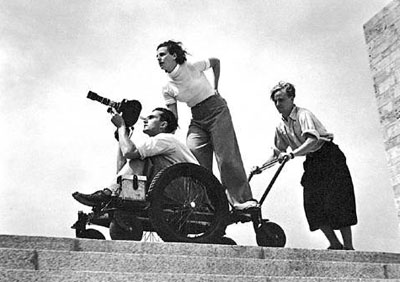
Film historians have seen Riefenstahl's influence in movies ever since. Star Wars, Citizen Kane, Gladiator, Lord of the Rings - all bear the marks of Riefenstahl's style. The famous opening scene of Triumph, in which the camera moves through the clouds to capture an aerial shot of the city of Nuremberg (to the music of Wagner, naturally) must have influenced Wim Wenders' opening of Wings of Desire. The sports documentarian Bud Greenspan, one of the finest filmmakers of the 20th century (Ken Burns could take a chapter from him), considers her one of the greats.

It's an assertion few would dispute, in the academic sense. But can’t you detect just the smallest bit of embarrassment whenever one praises the work of Riefenstahl? True, Triumph of the Will is a staple of many “best all-time” lists, but there’s this sense that even when we praise Riefenstahl, we must immediately apologize or explain away the praise, lest we fall under guilt-by-association. The closer we get to her work, the more we edge away from it. It’s not likely you’d hear Seinfeld emerge from the theatre saying, “It’s about Nazis! Not that there’s anything wrong with that.” (Warning: Do not insert any Soup Nazi jokes here.)
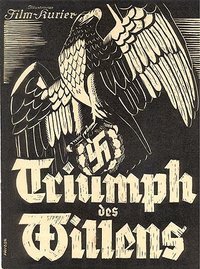
No, you’ll never hear anyone say there’s nothing wrong with being a Nazi. In our time the Nazi brand is, as I've said before, the Scarlet Swastika, an accusation so accursed that its use has become widespread, indiscriminate, a self-parody. And yet it is a charge that carries power, a negative sort of prestige, a stigma that taints whatever it touches. And we ask ourselves if we should be ashamed by our admiration and praise of the artist’s work, if we can morally separate the ideology of the artist from the art itself.

Riefenstahl’s work does not allow us that luxury. The subject matter of Triumph of the Will is in your face, and you can't ignore it. As the Wikipedia bio puts it, "it is nearly impossible to separate the subject from the artist behind it." She “claimed that she was naïve about the Nazis when she made it and had no knowledge of Hitler's genocidal policies. She also pointed out that Triumph contains ‘not one single anti-Semitic word’“; but it is difficult (although not impossible) to conceive of her as both ingénue and naïve girl, the brilliant and innovative filmmaker who was still a babe in the woods when it came to world politics. This is what she would have liked you to believe, but her actions often belie that contention. Roger Ebert points out, "the very absence of anti-Semitism in Triumph of the Will looks like a calculation; excluding the central motif of almost all of Hitler's public speeches must have been a deliberate decision to make the film more efficient as propaganda." And so, given all this, we’re tempted to see in her films things that aren’t really there, images that dance before us like the ghosts from black & white TV. Only these are real, the ghosts of Hitler’s victims that only become clearer as the picture is drawn into sharper focus.

Therefore, as viewers do we punish the filmmaker because of the subject of her films? Do we hold Riefenstahl accountable for her Nazi associations? And if so, do we also apply the same standards to Sergei Eisenstein, who exploited Russian nationalistic pride in Potemkin and Alexander Nevsky? (Yes, I know Eisenstein had his quarrels with the authorities, but large families often do that.) Eisenstein is often ranked in the pantheon of filmmaking, Potemkin appearing on most ten-best lists, but I rarely see him carrying around the baggage that accompanies Riefenstahl. And we won't even get into the almost-paranoid, conspiracy-laden propaganda of liberal filmmakers like Oliver Stone?

Now, it's true that Eisenstein wasn't a documentarian as was Riefenstahl. Nonetheless, his movies were fraught with nationalistic fervor, clearly designed to influence and inspire the viewer. (The Communists, in fact, thought Eisenstein worried too much about things like art and budgeting, and wanted even more propaganda in the content.) As for Stone - well, we know most of his films have an agenda.

Some like to pair up Triumph of the Will with Frank Capra’s direct answer to them, the Why We Fight series of films. (And, by the way, given how anti-American Hollywood has become, it would have been interesting to see how Capra's reputation might have suffered had he been young enough when he made this series. Surely in the Hollywood of the late 60s through today, he would have been seen as a toady for the government.)
In fact, however, the true companion to Riefenstahl’s masterwork might be D.W. Griffith’s The Birth of a Nation. This truly was a landmark of filmmaking, but most today remember it only as a racist piece of propaganda, glorifying the Ku Klux Klan. True, perhaps, but Griffith's influence, like Riefenstahl's, cannot be denied. True also that Griffith, like Riefenstahl, is held at arms' length by most.

So what's the point here? It's not an apology for Leni Riefenstahl (or D.W. Griffith, for that matter). It's merely an observation on how we allow our politics to color the way we see things. As I've asserted in the past, it is hard to believe that Riefensthal would be held in such contempt had the Triumph in question been Lenin's October Revolution.

As we watch the ridiculous accusations of Nazism that are so commonplace nowadays across the political blogosphere, and perhaps most absurdly from the Muslims who brand the Jews with the contemptuous tag, we are reminded that Nazism is the singular golden sin, the mark from which its bearers cannot recover. It is reminiscent of the "unforgivable sin" that Christ warns us of, though most of those wielding it would fail to recognize that analogy since they don't recognize the source.

National Socialism keeps us in a trance, as perhaps it should. It holds the figures of history hostage, as perhaps it might. But we do not diminish the horror of the truth it represents to assert also that the word "Nazi" is the crown jewel of political correctness, the golden spike to be driven through the heart, the one word that guarantees the discrediting of its intended. Some would wear the title as a badge of honor, an ideology to be embraced, others are shamed with a scarlet letter and their lips burn with Judas' kiss of betrayal, and still others feel the sting of its indiscriminant application.

But while Schwarzkopf shrugged off the label, and Riefenstahl tried to run from it, Richard Wagner might have welcomed it with open arms. But that's for another time.

The Harder He Falls

Posted by febry on 11:25 AM

By Mitchell Hadley

Here's a piece so good, you'd think we'd written it.

Before you think that's too egotistical, though, let us explain. Our regular readers know our habit of taking movies, television shows, or other stories, and spinning off our own versions - looking, in effect, for (apologies to Paul Harvey) "the rest of the story." (See this piece on Hogan's Heroes as an example of what we're talking about.)

Anyway, we've got this article from Tuesday's NRO, in which David Kahne combines two of our favorite genres - sports and politics - to come up with, as the header says, "the current travails of President Obama [as] run them through a Budd Schulberg prism." Schulberg, who died just a couple of weeks ago, wrote some of the hardest-hitting stuff of our time - What Makes Sammy Run, On the Waterfront, and one of the great movies on boxing and corruption, The Harder They Fall. (Which doubles as Humphrey Bogart's last movie.)

It is this movie that Kahne uses to study the presidency of Battlin' Barry Obama, “The Punahou Kid.” It's a fun piece, and as is often the case with fun pieces, it contains more than a gram of truth. Kahne skillfully tells the story of Obama's election, and then comes that "rest of the story" moment:

It took my agent all of two days to sell this baby to Fox, and it’s already slotted into the production pipeline right behind Mission to Pyongyang: The Bill Clinton Story. Naturally, I’m already at work on the sequel:

Fooled by his easy success, Barry chows down on burgers, vacations in Paris, takes up bowling, and even learns to fly-fish in Big Sky country. When his former opponent Hillary — old, fat, and out of shape, but part of his “Team of Rivals” — warns him to watch it, he packs her off to the Congo to look for Marlon Brando, and she has never heard from again. Meanwhile, a fast-rising challenger, Sarah “The Barracuda” Palin(Clint Eastwood, in the most daring role of his career), is making mincemeat out of various pugs, mugs, and tomato cans. Barry tries to duck her, but the cry goes up: Come out and fight like a man!

I’m kicking around a couple of titles: Trillion-Dollar Baby is one. Or maybe just keep it simple: The Harder He Falls: This Time, It’s Personal.


Read the whole thing. It's good. You'll want to remember it a few years from now...

Karl Malden, R.I.P.

Posted by febry on 12:40 PM

By Mitchell

Karl Malden was responsible, albeit one step removed, from one of my favorite sayings. I have often been heard, at work and elsewhere, to declare that "A good excuse is like an American Express card - don't leave home without it."

Perhaps Malden didn't write that memorable line forAmerican Express, but he was the one who said it - and after that it belonged to him, no matter who said it. There was a presence about him (the profile, the nose, the hat, the commanding voice) that served him well even when he wasn't hawking travelers' checks: in A Streetcar Named Desire, for which he won his Oscar; for On the Waterfront, with his gritty portrayal of a priest who understood exactly what social justice means; or in Patton, for which I think he should have won an Oscar, playing the difficult role of General Omar Bradley to perfection - a hero in his own right, Bradley had to be played as second banana to Patton without losing his dignity or stature. Not every actor could pull that off, but Malden could and did.

He was known to millions for his role in the cop show The Streets of San Francisco, where he mentored the star-to-be Michael Douglas, who in those days was better known for being Kirk's son. He went on to become president of the Academy of Motion Picture Arts and Sciences, a role he fulfilled honorably for many years.

Karl Malden died today at 97, a life well lived. He was never in the stratosphere of superstars, just a hard-working actor who did his job often and well, and never left it at home.

  • RSS
  • Delicious
  • Digg
  • Facebook
  • Twitter
  • Linkedin

Search Site